Enhancing Urban Biocapacity Assessment through High- Resolution Tree Cover Density Data: A Carbon Sequestration Proxy Approach
DOI:
https://doi.org/10.3097/LO.2026.1153Keywords:
urban biocapacity, Tree Cover Density, carbon dioxide sequestration, Green Infrastructure, ecological accounting, GIS workflowAbstract
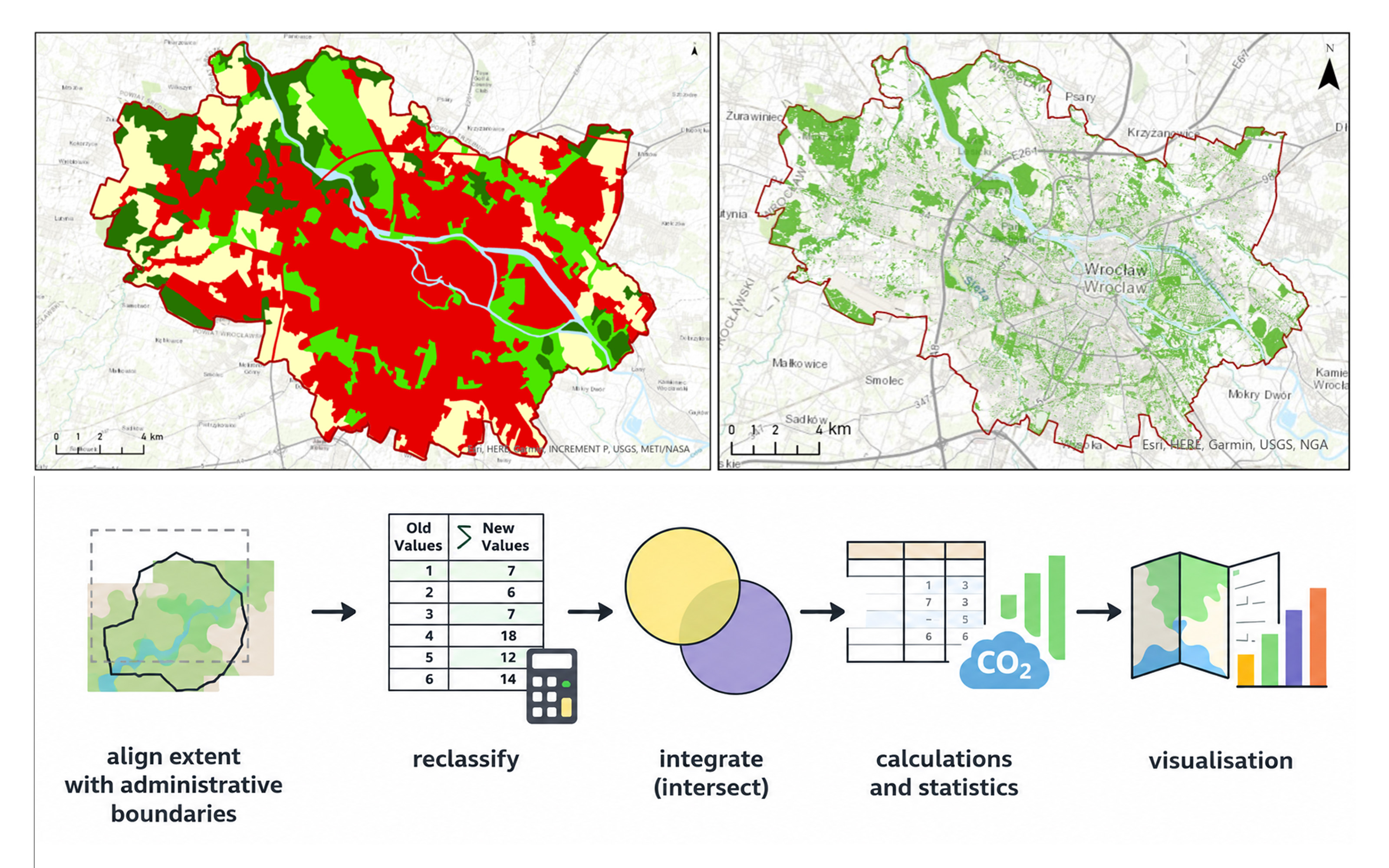
Accelerating ecological overshoot increases the need for spatially explicit ecological accounting, particularly in urban landscapes. Conventional biocapacity assessments often rely on generalized land-cover data that may overlook fine-scale vegetation structures. This study evaluates whether integrating high-resolution Tree Cover Density (TCD) data with Corine Land Cover (CLC) and Urban Atlas (UA) improves the spatial representation of vegetated land-use types and their carbon dioxide (CO2) sequestration potential. CO2 sequestration is used as a proxy for biocapacity rather than as a complete measure of ecosystem productivity. The approach was applied to Wrocław, Poland, using GIS to reclassify croplands, forest lands, and grazing lands and integrate them with TCD. Sequestration potential was then compared within the resulting CLC–TCD and UA–TCD areas using LUT-specific and TCD-weighted tree-specific sequestration rates applied to the same intersected spatial patches. The TCD-weighted approach reduced total estimated sequestration by approximately 57% for CLC and 53% for UA. Forest-land estimates declined by about 70% and cropland estimates by about 20%, whereas grazing-land estimates increased more than threefold. TCD can reveal dispersed woody vegetation within non-forest classes and provide a more spatially refined basis for urban ecological accounting and green-infrastructure planning, while requiring careful interpretation across land-use types.
References
Aggett, G., & McColl, C. (2006). Evaluating decision support systems for PPGIS applications. Cartography and Geographic Information Science, 33(1), 77–92. https://doi.org/10.1559/152304006777323163
Belčáková, I., Świader, M., & Bartyna-Zielińska, M. (2019). The green infrastructure in cities as a tool for climate change adaptation and mitigation: Slovakian and Polish experiences. Atmosphere, 10(9). https://doi.org/10.3390/atmos10090552
Benedict, M. A., & McMahon, E. T. (2006). Green infrastructure: Linking landscapes and communities. Island Press.
Borucke, M., Moore, D., Cranston, G., Gracey, K., Iha, K., Larson, J., Lazarus, E., Morales, J. C., Wackernagel, M., & Galli, A. (2013). Accounting for demand and supply of the biosphere’s regenerative capacity: The National Footprint Accounts’ underlying methodology and framework. Ecological Indicators, 24, 518–533. https://doi.org/10.1016/j.ecolind.2012.08.005
Budzik, G., Sylla, M., & Kowalczyk, T. (2025). Understanding urban cooling of blue–green infrastructure: A review of spatial data and sustainable planning optimization methods for mitigating urban heat islands. Sustainability (Switzerland), 17(1). https://doi.org/10.3390/su17010142
Copernicus. (n.d.-a). CORINE Land Cover — Copernicus Land Monitoring Service. Retrieved June 17, 2025, from https://land.copernicus.eu/en/products/corine-land-cover?tab=technical_summary
Copernicus. (n.d.-b). Urban Atlas — Copernicus Land Monitoring Service. Retrieved June 17, 2025, from https://land.copernicus.eu/en/products/urban-atlas?tab=technical_summary
Demuzere, M., Orru, K., Heidrich, O., Olazabal, E., Geneletti, D., Orru, H., Bhave, A. G., Mittal, N., Feliu, E., & Faehnle, M. (2014). Mitigating and adapting to climate change: Multi-functional and multi-scale assessment of green urban infrastructure. Journal of Environmental Management, 146, 107–115. https://doi.org/10.1016/J.JENVMAN.2014.07.025
Drew-Smythe, J. J., Davila, Y. C., McLean, C. M., Hingee, M. C., Murray, M. L., Webb, J. K., Krix, D. W., & Murray, B. R. (2023). Urban Forestry & Urban Greening Community perceptions of ecosystem services and disservices linked to urban tree plantings. Urban Forestry & Urban Greening, 82(127870). https://doi.org/10.1016/j.ufug.2023.127870
Dubicki, A., Dubicka, M., & Szymanowski, M. (2002). Klimat Wrocławia [eng. The climate of Wrocław]. Środowisko Wrocławia–Informator [Eng. Wrocław Environment – Handbook], 9–25. http://eko.org.pl/wroclaw/pdf/klimat.pdf
European Environment Agency. (2011). Green infrastructure and territorial cohesion. Technical Report Number 18.
Fritz, S., McCallum, I., Schill, C., Perger, C., See, L., Schepaschenko, D., van der Velde, M., Kraxner, F., & Obersteiner, M. (2012). Geo-Wiki: An online platform for improving global land cover. Environmental Modelling & Software, 31, 110–123. https://doi.org/10.1016/J.ENVSOFT.2011.11.015
Galli, A., Wackernagel, M., Iha, K., & Lazarus, E. (2014). Ecological Footprint: Implications for biodiversity. Biological Conservation, 173, 121–132. https://doi.org/10.1016/j.biocon.2013.10.019
Galli, A., Wiedmann, T., Ercin, E., Knoblauch, D., Ewing, B., & Giljum, S. (2012). Integrating Ecological, Carbon and Water footprint into a “footprint Family” of indicators: Definition and role in tracking human pressure on the planet. Ecological Indicators, 16, 100–112. https://doi.org/10.1016/j.ecolind.2011.06.017
Gao, T., Liu, Q., & Wang, J. (2014). A comparative study of carbon footprint and assessment standards. International Journal of Low-Carbon Technologies, 9(3), 237–243. https://doi.org/10.1093/ijlct/ctt041
Ghita, S. I., Saseanu, A. S., Gogonea, R. M., & Huidumac-Petrescu, C. E. (2018). Perspectives of ecological footprint in European context under the impact of information society and sustainable development. Sustainability (Switzerland), 10(9), 1–25. https://doi.org/10.3390/su10093224
Guo, J., Yue, D., Li, K., & Hui, C. (2017). Biocapacity optimization in regional planning. Scientific Reports, 7(January), 1–10. https://doi.org/10.1038/srep41150
Haberl, H., Erb, K. H., Krausmann, F., Gaube, V., Bondeau, A., Plutzar, C., Gingrich, S., Lucht, W., & Fischer-Kowalski, M. (2007). Quantifying and mapping the human appropriation of net primary production in earth’s terrestrial ecosystems. Proceedings of the National Academy of Sciences of the United States of America, 104(31), 12942–12947. https://doi.org/10.1073/pnas.0704243104
Hendriks, K., Gubbay, S., Arets, E., Janssen, J., Dige, G., & Erhard, M. (2020). Carbon stocks and sequestration in terrestrial and marine ecosystems: a lever for nature restoration? European Environment Agency, (November), 1–66. https://doi.org/10.2800/816798
Hernández-Salmerón, I. R., & Holmgren, M. (2022). Global meta-analysis: Sparse tree cover increases grass biomass in dry pastures. Frontiers in Environmental Science, 10(August), 1–9. https://doi.org/10.3389/fenvs.2022.949185
Hori, K., Shirahama, S., Hashimoto, S., Saito, O., Matsui, T., & Haga, C. (2023). Development of a method for downscaling ecological footprint and biocapacity to a 1 ‑ km square resolution. Sustainability Science, 18(3), 1549–1568. https://doi.org/10.1007/s11625-022-01283-z
Jenerette, G. D., & Herrmann, D. L. (2023). A global synthesis of reported urban tree carbon production rates and approaches. Frontiers in Ecology and Evolution, 11(January), 1–12. https://doi.org/10.3389/fevo.2023.1244418
Kazak, J. K., Świąder, M., Arciniegas, G., Aslanoğlu, R., Wascher, D., & Chrobak, G. (2023). The application of geoplanner in the management of local development. Acta Scientiarum Polonorum, Administratio Locorum, 22(4), 525–535. https://doi.org/10.31648/aspal.9012
Király, É., Illés, G., & Borovics, A. (2025). Green infrastructure for climate change mitigation: Assessment of carbon sequestration and storage in the urban forests of Budapest, Hungary. Urban Science, 9(137), 1–20. https://doi.org/10.3390/urbansci9050137
Labohm, B., Wolff, M., & Haase, D. (2025). Integration of high-resolution data for a complementary assessment of forest dynamics in Europe. MethodsX, 14(April), 1–10. https://doi.org/10.1016/j.mex.2025.103303
Lin, D., Hanscom, L., Murthy, A., Galli, A., Evans, M., Neill, E., Mancini, M. S., Martindill, J., Medouar, F.-Z., Huang, S., & Wackernagel, M. (2018). Ecological Footprint accounting for countries: Updates and results of the National Footprint Accounts, 2012–2018. Resources, 7(3), 58. https://doi.org/10.3390/resources7030058
Liu, Y., Zhao, W., Zhang, Z., Ding, J., & Wang, L. (2026). A 30 m spatial resolution dataset of ecosystem services in China for 2000, 2010, and 2020. Earth System Science Data, 18(2), 1519–1540. https://doi.org/10.5194/essd-18-1519-2026
Mądzik, M., & Świąder, M. (2025). Carbon footprint assessment for sustainable spatial management in urban settlements: Study of Polish cities. Geomatics and Environmental Engineering, 19(1), 25–66. https://doi.org/10.7494/geom.2025.19.1.25
Mancini, M. S., Galli, A., Coscieme, L., Niccolucci, V., Lin, D., Pulselli, F. M., Bastianoni, S., & Marchettini, N. (2018). Exploring ecosystem services assessment through Ecological Footprint accounting. Ecosystem Services, 30, 228–235. https://doi.org/10.1016/J.ECOSER.2018.01.010
Matemilola, S., & Sijuade, T. (2020). Encyclopedia of Sustainable Management. Encyclopedia of Sustainable Management, (September 2020). https://doi.org/10.1007/978-3-030-02006-4
Monfreda, C., Wackernagel, M., & Deumling, D. (2004). Establishing national natural capital accounts based on detailed Ecological Footprint and biological capacity assessments. Land Use Policy, 21(3), 231–246. https://doi.org/10.1016/j.landusepol.2003.10.009
Monteiro, R., Ferreira, J. C., & Antunes, P. (2020). Green Infrastructure Planning Principles : An Integrated Literature Review. Land, 9(525), 1–19. https://doi.org/doi:10.3390/land9120525
Moore, J., Kissinger, M., & Rees, W. E. (2013). An urban metabolism and ecological footprint assessment of Metro Vancouver. Journal of Environmental Management, 124, 51–61. https://doi.org/10.1016/j.jenvman.2013.03.009
Municipality of Wrocław. (2024). Wrocław 2050. Aktualizacja: Diagnoza przestrzenna obszaru Wrocławia - aneks [eng. Wrocław 2050. Update: Spatial Analysis of the Wrocław Area – Annex]. https://www.wroclaw.pl/beta2/files/news/791150/Diagnoza-przestrzenna_aktualizacja-2024.pdf
Pianegonda, A., Favargiotti, S., & Ciolli, M. (2022). Rural–urban metabolism: A methodological approach for carbon-positive and circular territories. Sustainability (Switzerland), 14(21). https://doi.org/10.3390/su142113964
Pinto, L. V., Inácio, M., & Pereira, P. (2023). Green and blue infrastructure (GBI) and urban nature-based solutions (NbS) contribution to human and ecological well-being and health. Oxford Open Infrastructure and Health, 1(October), 1–14. https://doi.org/10.1093/ooih/ouad004
Rees, W., & Wackernagel, M. (2012). “Urban ecological footprints: Why cities cannot be sustainable “and why they are a key to sustainability”: From urban ecology (2008) [1996]. The Urban Sociology Reader, Second Edition, 9255(96), 157–165. https://doi.org/10.4324/9780203103333-26
Safaei, M., Bashari, H., Kleinebecker, T., Fakheran, S., Jafari, R., & Große‑Stoltenberg, A. (2023). Mapping terrestrial ecosystem health in drylands : comparison of field ‑ based information with remotely sensed data at watershed level. Landscape Ecology, 38(3), 705–724. https://doi.org/10.1007/s10980-022-01454-4
Świąder, M., Szewrański, S., & Kazak, J. K. (2020). Environmental carrying capacity assessment—the policy instrument and tool for sustainable spatial management. Frontiers in Environmental Science, 8(November). https://doi.org/10.3389/fenvs.2020.579838
Świąder, M., Szewrański, S., Kazak, J., van Hoof, J., Lin, D., Wackernagel, M., & Alves, A. (2018). Application of ecological footprint accounting as a part of an integrated assessment of environmental carrying capacity: A case study of the footprint of food of a large city. Resources, 7(3), 52. https://doi.org/10.3390/resources7030052
Szmytkie, R. (2021). Suburbanisation processes within and outside the city : The development of intra-urban suburbs in Wrocław , Poland. Moravian Geographical Reports, 29(2), 149–165. https://doi.org/10.2478/mgr-2021-0012
Tasan, M., Dąbrowska, J., Michałowska, K., & Uciechowska-Grakowicz, A. (2025). Long-term dynamics of urban heat island and hot spots in Wrocław : A 25-year satellite-based analysis using machine learning. Sustainable Cities and Society, 132(106797). https://doi.org/10.1016/j.scs.2025.106797
Verburg, P. H., Neumann, K., & Nol, L. (2011). Challenges in using land use and land cover data for global change studies. Global Change Biology, 17(2), 974–989. https://doi.org/10.1111/j.1365-2486.2010.02307.x
Vigier, M., Ouellet-Plamondon, C. M., Spiliotopoulou, M., Moore, J., & Rees, W. E. (2023). To what extent is sustainability addressed at urban scale and how aligned is it with Earth’s productive capacity? Sustainable Cities and Society, 96(May), 104655. https://doi.org/10.1016/j.scs.2023.104655
Wackernagel, M., Onisto, L., Bello, P., Linares, A. C., Falfán, I. S. L., García, J. M., Guerrero, A. I. S., & Guerrero, M. G. S. (1999). National natural capital accounting with the ecological footprint concept. Ecological Economics, 29(3), 375–390. https://doi.org/10.1016/S0921-8009(98)90063-5
Wackernagel, M., & Rees, W. (1998). Our ecological footprint: reducing human impact on the earth. New Society Publisher.
Wang, H., & Hu, Y. (2021). Simulation of biocapacity and spatial-temporal evolution analysis of Loess Plateau in Northern Shaanxi Based on the CA – Markov Model. Sustainability (Switzerland), 13(5901). https://doi.org/10.3390/su13115901
WWF. (2022). Living Planet Report 2022 – Building a nature- positive society. Almond, R.E.A., Grooten, M., Juffe Bignoli, D. & Petersen, T. (Eds). WWF, Gland, Switzerland.
Yang, P., Zhang, X., & Hua, L. (2023). Analysis of urban ecological quality spatial patterns and influencing factors based on remote sensing ecological indices and multi-scale geographically weighted regression. Sustainability (Switzerland), 15(7216). https://doi.org/10.3390/su15097216
Yue, D., Guo, J., & Hui, C. (2013). Scale dependency of biocapacity and the fallacy of unsustainable development. Journal of Environmental Management, 126, 13–19. https://doi.org/10.1016/J.JENVMAN.2013.04.022
Zomer, R. J., Neufeldt, H., Xu, J., Ahrends, A., Bossio, D., Trabucco, A., Van Noordwijk, M., & Wang, M. (2016). Global tree cover and biomass carbon on agricultural land: The contribution of agroforestry to global and national carbon budgets. Scientific Reports, 6(April), 1–12. https://doi.org/10.1038/srep29987
Downloads
Additional Files
Published
How to Cite
Issue
Section
Categories
License
Copyright (c) 2026 Małgorzata Świąder

This work is licensed under a Creative Commons Attribution 4.0 International License.